
Imaginary Peaks: The Riesenstein Hoax and Other Mountain Dreams
Katie Ives
26 September 2022 · reviewed by Heather Dawe
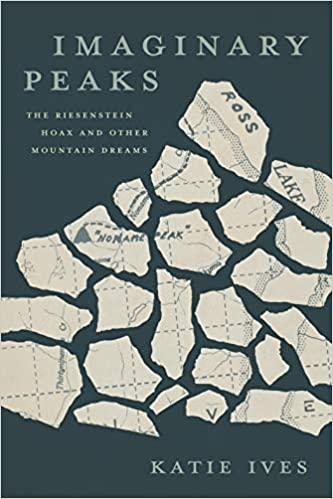
Buy a copyImaginary Peaks is a wide-ranging exploration of the ways mountains inspire us to dream. Published in October 2021 by Mountaineers Books in North America, it is the first book of Katie Ives, the celebrated and recently outgoing Editor-in-Chief of Alpinist.
A graduate of Harvard and the Iowa Writers’ Workshop, Ives is one of the most well-read living scholars of mountaineering history and mountain culture. Imaginary Peaks reflects this, the book’s sweep of the literature is both broad and deep. In her role at Alpinist , she was known for the quality of her editorial standards and the ways she worked with the magazine’s contributors to help them with the crafting of their writing. These standards are maintained in her own prose throughout this book – the words flow beautifully and are meticulously researched; rich descriptions of place and experience.
Ives uses the Riesenstein Hoax to springboard into the diverse ways mountains have inspired the human imagination. Concocted by American Harvey Manning and friends in the 1960s, the US climbing press of the time reported their stories of untouched rock spires: the “remote Reisenstein Peaks of British Colombia” as new discoveries, leading to excitement and intrigue in the North American climbing community, until they realised it all was a fabrication.
While much of Imaginary Peaks is centred on Manning, his contemporaries, what led them to concoct such a story and set it in the American North-West, Ives explores how legends, folklore, fiction and religion from around the world have shaped the way we imagine mountains. Xanadu, the goddess Nanda Devi, Tír na nÓg, The Lord of the Rings and the Aboriginal Dreamtime are just a few of the places and stories Ives takes us on this journey.
Ives so explores the mountain cultures and history of Indigenous peoples as well as Western mountain culture and history, recognising how the former both pre-dates and has been frequently overlooked by the latter. She writes sensitively, thinking of the feelings within the experiences of those she writes. Ives makes it clear that mountain-going and mountain culture are holistic things, with many individual views, perceptions and stories, all of which should be considered and valued as part of the whole.
Imaginary Peaks is a book that discusses many threads, the subjects Ives explores are expansive. I found the best state of mind to be in when reading was just to immerse myself and follow Ives thinking, not worrying about where the flow would next be heading. In doing so I saw more connections between things, as seemingly disparate entities are expertly linked by Ives’ lucid prose. To do this so effectively requires a wide and deep knowledge of the subjects, a great deal of empathy and a minimal amount of ego.
For a long time, mountain exploration has been underpinned by a wonder akin to that of children, a significant part of which was felt due to things that were larger than us, out with our capabilities to control. Now, with the highest peaks climbed, a map of anywhere in the world is available to us in a few swipes of our fingers, and a Himalayan rescue can be arranged via WhatsApp, while we don’t have things fully under our control, we are closer than ever. And with such feelings of control can come a loss of the wonder. This book is a celebration of that wonder, showing it to us again and again.
While reading Imaginary Peaks , I found myself questioning whether Ives was at all worried that, in writing a book that forensically explores the mystery of mountains, she would take at least some of it away for the reader. This book does not do that, quite the opposite. In showing us that in the mountains there are still many things larger than us, it encourages us to dream. On a personal level it led me to think about and imagine all kinds of things, helping to initiate a stream of creativity that I am still bouncing off.
Heather Dawe's latest book is Mountain Stories , an illustrated memoir of journeys through some of Scotland's most beautiful landscapes, including Skye's Cuillin, Knoydart, Assynt and the Far North. Writing during lockdown, author and artist Heather Dawe finds telling these stories a powerful means of reconnection with the mountains when they are physically inaccessible. Dawe's journeys are made by walking, running, cycling or sea-kayak. These stories are a reflection of the importance of wild places and the inspiration, art and culture associated with them.